The Nexus
A skills group, not therapy. Your facilitator is a peer, not a clinician.
Listen to this chapter12 min
Chapter 8 of the audiobook, The Nexus. This audiobook is narrated by a synthetic voice, cloned from a recording of the author's own voice. The words and the voice are his; the reading is synthesised rather than performed. Download this chapter.
Growth is not required after a Nexus. Survival is sufficient.
Post-traumatic growth is a real finding, and it gets weaponised — into the idea that you're supposed to emerge from the worst thing that ever happened to you improved (Tedeschi & Calhoun, 1996). You are not.
If you got through it, you did the thing. Anything after that is optional.
The Nexus Protocol
Where it stops. Nothing in this session would have prevented the event. What this session is for is everything that came after it. Growth is not required either. The research says growth can follow deliberate engagement with an event like this. It says can, not does, and surviving is a sufficient outcome. Anybody who offers you the version where the event was secretly a gift is selling something.
- Stabilise the body first — run the Body Reset (Session 2) before anything else.
- Make the situation smaller — address only the next immediate practical step.
- Ensure connection — do not be alone with this if being alone is harmful.
- Use simple language — avoid analysing what this means. That work comes later.
- Delay all large conclusions — "I am not deciding what this means forever. I am deciding what to do next."
- When the acute phase passes, return for meaning-making. Not before.
- Close the Loop for surviving this moment. Not for handling it well. For getting through the hour.
Fast version — under sixty seconds
Body first — one exhale, feet on the floor. Smaller — what's the one next practical thing? Connect — who can be here with you? Delay meaning — not now, later.
Use it when
- A significant loss, betrayal or failure has just occurred
- You cannot see beyond the current moment
- The event feels so large that all other tools seem inadequate
- Someone you're supporting is in the acute phase of a high-impact event
What to expect
You may not feel resolved, and repair is not the same as feeling better. The body settles first; a conversation started from a steadier state asks less of both people.
"This is important. We go slowly."
Time perception distorts — and that is normal
Under high activation, your sense of time may feel slowed, frozen, fragmented, or lost entirely. People lose hours. People remember events in slow motion, or as disconnected pieces.
These are normal neurological responses — not signs of fragility, and not pathology. Knowing it in advance removes a whole second layer of distress: the fear that something is wrong with you, on top of the thing that has actually happened.
If you're with someone whose sense of time has gone strange: "Your sense of time may be off right now. That's the nervous system doing its job. Come back to this moment — what do you see in front of you right now?"
Why it works
The order is not a preference. Trauma recovery research identifies the same sequence this protocol follows: safety and stabilisation first, then processing, then integration and meaning-making (Herman, 1992). Attempting to skip to meaning-making before stabilisation is not merely ineffective; it tends to make later processing harder. If you have ever been pushed to "talk about it" before you could breathe properly and it made things worse, that was not you failing at recovery. The order was wrong.
Delaying conclusions interrupts false authority. Under extreme activation the mind tries to make the event mean something final — "this defines me," "I'll never recover." Those conclusions arrive with enormous authority and are formed precisely when your capacity to assess anything is lowest. The replacement is not denial; it is the deliberate postponement of meaning-making until the window is wide enough to hold it accurately.
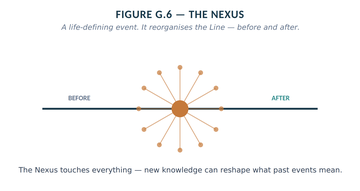
Connection is structural, not emotional. Isolation during a high-impact event increases the risk of the event consolidating as a permanent identity rather than a point on the Line that can be integrated. The presence of a trusted person recalibrates the nervous system's threat assessment and widens the window enough for the next step to become visible. The person who sits with you and says almost nothing is doing more than the person with the best advice.
Post-traumatic growth — carefully. Five domains can emerge from deliberate engagement with a Nexus: greater personal strength, awareness of new possibilities, deeper relationships, heightened appreciation of life, and shifts in existential understanding. Can — not will, and not should. The timeline is not fixed; weeks, months and sometimes years separate the acute event from any of it.
In practice — a sudden job loss, not seen coming. What is known two weeks later is not what was known on the day—that there was support that had not been counted. What grew was noticed afterwards rather than aimed at.
If you are supporting someone else
The script
"Stay with me. We are not solving this right now. We are just here." "Your body first — let's run the Body Reset together." "What is the one next practical thing? Not the whole problem — the next thing." "We are not deciding what this means forever. We are deciding what to do in the next hour."
The co-do version
"I am going to sit here with you. That is the only job I have right now." "Let's breathe together. One exhale. Just that." "What does your body need right now — a drink of water, a blanket, to sit together?"
For children in a Nexus
"I am here. You are safe right now." "We do not need to figure everything out. Just this moment." "The feelings are very big right now. They will change. I am going to stay with you." "You do not have to explain anything. I am not going anywhere."
Never say this
| Don't | Why it fails |
|---|---|
| "Everything happens for a reason." | Imposes meaning during the acute phase — premature, and often harmful |
| "At least…" | Minimises the experience by comparing it to something worse |
| "You need to stay strong." | Implies that the emotional response is weakness |
| "I know how you feel." | Even well-intentioned, it redirects attention to the helper |
| "What doesn't kill you makes you stronger." | Imposes a growth obligation on someone who is surviving |
Most of us have said all five. They come from people who care and cannot bear to watch, which is why they are so hard to stop saying. The replacement for all five is shorter: "I'm here. I'm not going anywhere."
The helper note — modelling what the other side looks like
When you navigate a significant difficulty and let the people close to you see — gradually, appropriately, without burdening them — that it could be survived and that something could be built from it, you give them one of the most durable psychological gifts available: a lived template.
Not the story of how hard it was. The story of what grew from the engagement with it, told at the right time and in the right terms. That teaches a child that the Nexus is not the end of the Line — it is the point where the Line can change direction most profoundly.
Operational Rule
Stabilise the body. Let meaning come later. Meaning comes when the window is wide enough to hold it.
This week — one thing
If you left "what helps me right away" blank, fill it in. That's all. Write the instructions while you're calm, for a version of you who won't be able to think.
If tonight stays with you: run the Body Reset before bed. The numbers at the top of this page work all night.
In the workbook: WB 1.8 builds your own version. WB 2.8 is Nexus post-event processing — for
later, not for the acute phase.
If you need next: Repair a relationship affected by the Nexus → Session 9 (next week). The Nexus has become a repeating pattern → Session 5. You are in crisis and not safe → Session 17, and the numbers above, tonight.
Equipped With Agency · Session 8 of 17 · Next week: The Repair
Sources
The full entries for the research named on this page. Every one of them is also in the reference list at the back of the manual.
- Post-traumatic growth: Tedeschi, R.G. & Calhoun, L.G. (1996). Journal of Traumatic Stress, 9(3), 455–471.
- Trauma recovery: Herman, J.L. (1992). Trauma and Recovery. Basic Books.