The Wave
A skills group, not therapy. Your facilitator is a peer, not a clinician.
Listen to this chapter12 min
Chapter 7 of the audiobook, The Wave. This audiobook is narrated by a synthetic voice, cloned from a recording of the author's own voice. The words and the voice are his; the reading is synthesised rather than performed. Download this chapter.
The Wave Protocol
Where it stops. The Wave asks you to weigh the next hour against the next year and to choose. A dependency does not arrive as a preference. The body is making its own case, it goes on making it after you have chosen, and it does not get quieter because you mapped the ripple accurately. Session 17 is what to do about it, and medical advice about withdrawal is not optional.
- Pause before acting — five seconds. Ask: "What will this create?"
- Map the short-term result — what happens in the next hour?
- Map the medium-term result — what does this reinforce over the next month?
- Map the long-term result — who does this make me, one year from now?
- Choose the smallest action with the best long-term ripple — not the most dramatic. The most consistent.
- Reinforce with the Self-Reward Loop when you choose the longer-term option under short-term pressure.
Fast version — under sixty seconds
Pause. What will this create? Short — what happens in the next hour? Long — who does this make me in a year? Choose the smallest good wave.
Use it when
- You're about to make a reactive decision under pressure
- You're choosing the short-term option and know the cost is coming
- You want to build a habit but the daily effort feels insignificant
- A small daily choice is presenting itself and you want to choose deliberately
What to expect
The choice may still look small, but you will have weighed it against next month and next year rather than only against the next hour.
"One choice becomes a wave."
Short-term vs long-term
| Choice | Short-term | Medium-term | Long-term wave |
|---|---|---|---|
| Avoid the difficult conversation | Relief from immediate discomfort | Resentment accumulates. Distance grows | The relationship deteriorates or ends |
| Have the conversation, with the repair protocol | Discomfort, then resolution | Trust strengthens. Pattern shifts | The relationship deepens |
| Skip sleep to finish more work | Feels productive tonight | Cognitive performance decreases tomorrow | Depletion becomes baseline. Capacity shrinks |
| Protect sleep consistently | One evening less done | Consistent performance | Compounding capacity over months |
| Use the regulation tool when the urge to react is present | Small friction, slightly harder | Pattern begins to shift | New default response built into neural architecture |
| React automatically | Immediate relief of the impulse | Pattern reinforces | Pattern becomes harder to interrupt |
The last two rows are this whole series, mapped.
Why it works
Temporal discounting is architecture, not weakness. Your brain systematically weights a reward available now more heavily than an equivalent reward available later. That's not a character flaw — it's how valuation works, in everyone. Which means the long-term choice competes at a structural disadvantage, every time, and "try harder" does not change the maths.
The Self-Reward Loop is the counterweight. It generates an immediate, present-moment neurological signal of acknowledged effort, which partially compensates for the delayed return. It puts a reward on the good wave now, where the brain can see it. That's why it's step 6 of the protocol — not a nice way to finish, but the thing that makes the long-term choice survivable.
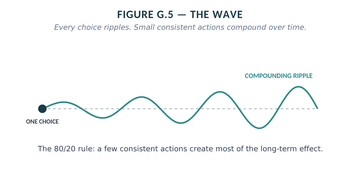
The vital few. Approximately twenty percent of inputs generate approximately eighty percent of results. A small number of consistently repeated daily choices generate most of your positive trajectory. Identifying those and protecting them beats trying to optimise everything at once.
The five-second pause. Most reactive decisions are made in under two seconds. Inserting a pause and the question "what will this create?" shifts processing from the automatic fast system to the deliberate slow one. The three-horizon mapping expands the frame beyond the immediate impulse.
Frequency beats intensity. One regulation tool used daily produces more neural change than ten tools used occasionally. Median time for a behaviour to become automatic is around sixty-six days, with a range from roughly eighteen to two hundred and fifty-four depending on complexity. If you're three weeks in and it still feels effortful, that is the normal middle — not failure.
In practice — checking the phone first thing in bed. The next hour costs twenty minutes; the next month, anxious mornings; the next year, scattered focus as a habit. The smallest better choice is the phone charging across the room.
If you are supporting someone else
The script
"What will this choice create — in ten minutes, in ten days, in ten months?" "What is the smallest version of the better choice that you would actually do consistently?" "What is the twenty percent of daily choices that generates most of your positive momentum? Protect those first."
The co-do version
"Let's map this choice together: short-term result, medium-term, long-term. What does each look like?" "Let's find your vital few — the three or four small daily choices that matter most — and protect them this week."
For children
"What happens right after this choice? What happens the day after?" "What kind of person do you want to be? Does this choice move toward that or away?" "What is the tiny version of the good choice — the version you could do right now?"
Never say this
| Don't | Why it fails |
|---|---|
| "You'll regret this later." | Predicts shame without offering a tool |
| "Think about the consequences." | Too vague to execute under impulse pressure |
| "This is going to come back to bite you." | Threat-based framing, which increases reactivity |
| "You never think ahead." | An identity label that reinforces the pattern |
Every one of these is a warning. None is a method — and the brain discounts the warning too.
The helper note — the wave they are watching
Children read the waves produced by the adults around them far more carefully than those adults realise. They notice whether the Self-Reward Loop gets used or abandoned. They learn the relationship between short-term and long-term thinking by watching it in action, not by being taught it as a concept.
The most powerful Wave teaching is the visible repair of a poor choice: acknowledging the short-term option you took, naming what it created, and choosing differently next time — out loud, where they can see it. Acknowledge, learn, choose again. That sequence is the Wave, and doing it in public teaches more than getting it right the first time ever could.
Operational Rule
Choose the smallest consistent action with the best long-term ripple.
This week — one thing
Your smallest good wave. Once a day, for a week. Close the loop every single time — that's not optional this week, that's the experiment.
In the workbook: WB 1.7 builds your own version. WB 2.7 is extended wave mapping. WB 8.7 is a
blank template to reuse.
If you need next: The Wave keeps collapsing because motivation isn't sustaining → Session 16. The pattern behind the poor choice needs interrupting → Session 5. A high-impact event has disrupted the trajectory → Session 8.
Next week is The Nexus — high-impact events: loss, betrayal, failure, the things that change how you see yourself. It's a heavier session. The same rules apply: go as shallow as you like, pass on anything, step out any time you need to.
Equipped With Agency · Session 7 of 17 · Next week: The Nexus
Run it — The Wave Protocolunder 3 min