The Sphere
A skills group, not therapy. Your facilitator is a peer, not a clinician.
Listen to this chapter13 min
Chapter 6 of the audiobook, The Sphere. This audiobook is narrated by a synthetic voice, cloned from a recording of the author's own voice. The words and the voice are his; the reading is synthesised rather than performed. Download this chapter.
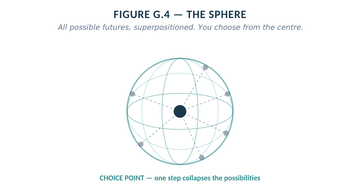
The Sphere Protocol
Where it stops. This chapter does not close spheres. Nothing in it resolves an uncertainty a day earlier or takes an hour off anybody's wait. It has a floor as well: sorting needs enough room to sort in, and past a certain intensity there is none. When you cannot see a path and have stopped being able to move, this is not the chapter.
- Write the worry down — give it a specific, bounded form outside your head.
- Sort it — is this actionable now, real but not yet, or purely hypothetical?
- If actionable now — identify the one next step. That step only.
- If real but not yet — schedule a specific time to revisit it. Put it down until then.
- If hypothetical — name it as a guess and return attention to the present.
- Rate the uncertainty 0–10. What would make it one point lower?
- Close the Loop.
Why "later" doesn't work: your mind will not put something down unless it knows when it gets picked up. Put an actual date on it.
Fast version — under sixty seconds
Write the worry in one sentence. Sort: can I act on this right now, yes or no? If yes — one step, do it. If no — schedule it, put it down.
Use it when
- Your mind is generating possible futures faster than you can evaluate them
- You're trying to plan for every contingency and feel paralysed
- The uncertainty about a decision is costing more than the decision itself
- You can't sleep because your mind is running simulations
- You're trying to control something that isn't within your power
What to expect
The worry may not go quiet. It ends up sorted into three: something you can act on, something with a date on it, or something you have named as a guess. A named guess argues back less.
"I do not need the whole future. I need the next step."
The Uncertainty Scale
| Rating | What this level looks like | The response |
|---|---|---|
| 0–3 · Manageable | Some unknowns, but overall direction is clear | Continue with the current plan. No special intervention |
| 4–6 · Elevated | Multiple unknowns. Outcome unclear. Some anxiety | Identify the one next step. Schedule a check-in. Build one contingency |
| 7–8 · High | Significant unknown. Planning difficult. Worry consuming attention | Run the Sphere Protocol. Separate facts from guesses. Contact one person for perspective |
| 9–10 · Critical | Complete uncertainty. No path visible. Paralysis | Return to the Now (Ch 1). Regulate through the Body (Ch 2). Then come back here |
At nine or ten you do not use this session. You go back to Sessions 1 and 2 and return when you can think.
The Dichotomy of Control
The Stoic tradition, articulated by Epictetus, gives the sharpest structural tool for the Sphere. Divide every worry into two categories only:
- What is within your power — your choices, your responses, your effort. Direct all effort here.
- What is not — outcomes, other people's decisions, the future. Release it entirely.
This is not passivity. It is the most efficient possible use of finite energy. Most worried energy is directed at outcomes that are either not within the person's control or have not yet occurred. Releasing what you cannot change does not reduce the importance of the outcome — it stops you spending where the spending cannot reach.
What percentage of your current worry energy is directed at things that are not within your power to change?
What is not yours to carry
The Dichotomy of Control is a tool for worry. It is not a claim that everything outside your power is therefore trivial, or that a person with fewer options simply needs a better attitude. Some of what sits outside your control is structural, and naming that is part of using the tool honestly rather than a caveat on it.
Canada names twelve social determinants of health — income and social status; employment and working conditions; education and literacy; childhood experiences; physical environments; social supports and coping skills; healthy behaviours; access to health services; biology and genetic endowment; gender; culture; and race and racism.
Between them they account for far more of how a life goes than any coping tool does.
Both things are true at once. Housing, income, and whether the system believes you — none of that is fixable by a protocol. And there is still a next ten minutes, and it is still yours. This series works on the second. It does not pretend to work on the first, and anyone who tells you the first is a mindset problem is selling something.
Why it works
Externalising reduces arousal. Writing the worry down moves it from an open loop in your attention to a bounded thing on a page. A worry in your head has no edges; a worry on paper has a beginning and an end.
The triage matches response to category. Most worry runs the same undifferentiated simulation whether or not there is anything to be done. Sorting is the intervention: actionable worries get a next step, not-yet worries get a scheduled time, hypothetical worries get named as guesses and set down.
Temporal discounting drives premature decisions. The brain prefers immediate resolution over sustained uncertainty, which produces the urge to make any decision just to end the discomfort of not-knowing. The Sphere Protocol replaces that impulse with a structured pause — hold the field open until genuine information is available.
Walking helps. Ten to twenty minutes of deliberate walking with attention on the physical sensation of each step. Rhythmic bilateral movement has a dampening effect on the threat response.
In practice. ‘What if my contract is not renewed?’ The triage says real, but not yet—the decision is six weeks away. Within reach: the work itself. Outside it: their budget. Revisit on the fifteenth.
The Best Possible Self exercise
Worth a quiet weekend. Write continuously for ten to fifteen minutes on the prompt: "Imagine everything has gone as well as it possibly could. You have worked hard and succeeded at all your life goals. What does that look like?"
Then sort what you wrote using the three piles — actionable now, real but not yet, hypothetical. Act on the first. Schedule the second. Name the third as a guess and set it down.
The sorting is what makes it more than daydreaming.
If you are supporting someone else
The script
"Let's put the worry in writing — give it a form outside your head." "Is this something you can do something about right now? Yes, no, or not yet?" "What is the one next step — not the whole solution, the next step?" "What would you need to know or have in order for this to feel one point less uncertain?"
The co-do version
"Let's write down every worry on separate pieces of paper. Then we'll sort them into three piles: act now, revisit later, and hypothetical." "Let's rate the uncertainty together. What number is it right now? What would make it one point lower?" "Let's go for a walk together. We don't need to solve anything — just move."
For children
"Let's put the worry in the worry box. Write it down or draw it." "Is this something that might happen, or is it definitely going to happen?" "What is one thing we can do today? Just one." "We will think about the rest on [a specific day]. Right now, let's do this one thing."
Never say this
| Don't | Why it fails |
|---|---|
| "Don't worry about it." | Dismisses the experience without offering a tool |
| "Everything will be fine." | Makes a promise that cannot be kept and teaches false certainty |
| "You're worrying about nothing." | Invalidates the internal experience |
| "Just stop overthinking." | Commands a cognitive process that cannot be stopped on demand |
| "Cross that bridge when you come to it." | Correct in principle, but offers no mechanism for putting the worry down |
That last one is the only entry in any of these lists that is actually correct. It's just useless, because it gives no method. This chapter is the method.
The helper note — the modelled relationship with uncertainty
Children calibrate their tolerance of uncertainty from the adults around them. A parent who models avoidance, catastrophising, or compulsive reassurance-seeking teaches the child that uncertainty is intolerable. A parent who stays regulated in the face of genuine not-knowing builds the child's capacity to hold the Sphere.
The sentence is: "I'm not sure what will happen, and that's okay. Here's what I do know, and here's what we can do next."
You do not have to have answers. You have to be able to not have them, out loud, calmly.
Operational Rule
Triage the worry. Act on what is actionable now. Set down the rest.
This week — one thing
Sort one worry. If it lands in "not yet," put the date in your phone tonight. Ten seconds — and it's the difference between a system and a good intention.
In the workbook: WB 1.6 builds your own version. WB 2.6b is extended uncertainty triage.
WB 2.14b is the Dichotomy of Control.
If you need next: The uncertainty is producing body activation → Session 2. The worry is a repeating loop → Session 5. You need daily habits that hold the line → Session 16.
Equipped With Agency · Session 6 of 17 · Next week: The Wave
Write it here
One uncertainty, sorted, before you leave the room.
The uncertainty consuming the most attention right now
Triage — is it actionable now, real but not yet, or hypothetical?
What is within my power here
What is not within my power here
If actionable, my one next step — or if not yet, the date I will revisit it
This page is worksheet 1.6 of the Equipped With Agency Workbook. Keep it where you will see it.
Run it — The Sphere Protocolunder 3 min