The Circle
A skills group, not therapy. Your facilitator is a peer, not a clinician.
Listen to this chapter14 min
Chapter 5 of the audiobook, The Circle. This audiobook is narrated by a synthetic voice, cloned from a recording of the author's own voice. The words and the voice are his; the reading is synthesised rather than performed. Download this chapter.
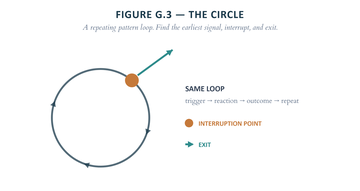
The Circle Protocol
Where it stops. Everything here treats a pattern as a sequence you can get in front of. Some patterns are not only that. Cue, routine and reward describes a cigarette accurately enough and describes a dependency on alcohol or opioids far less well, because a chemical dependency has a body underneath it that is now expecting the substance and will make its own case for it regardless of what you have decided. Run this protocol at that and you will conclude something false about yourself. Reducing the damage counts, whether or not abstinence is the goal, and medical advice about withdrawal is not optional.
- Name the loop — "the pattern I keep returning to is…"
- Map the sequence — what happens first, second, and third?
- Identify the earliest detectable signal — the first sign the loop is beginning.
- Find the interruption point — where a different action can be inserted.
- Choose one replacement step — not the whole pattern. One step.
- Rehearse the replacement mentally before you need it.
- Close the Loop when you use it.
Worked example
Every time this person receives critical feedback at work, they withdraw for days — avoiding the colleague, ruminating, then overcompensating with extra work until they're exhausted.
Step 1: the feedback. Step 2: tight chest, shame flush ← the earliest signal. Step 3: withdrawal.
Replacement: when the tight chest appears → "I'm going to take five minutes, then ask one clarifying question about the feedback." Rehearsed during a calm state. Next time the feedback arrives, they catch the tight chest and break the loop at step 2 instead of proceeding to step 3.
Fast version — under sixty seconds
Name the loop, one sentence. Spot the earliest signal — what happened first? Replace one step — the smallest possible different action. Do it now.
Use it when
- A familiar argument, response or outcome is unfolding again
- You can feel the pattern starting and want to interrupt early
- You've tried to change this before and it returned
- The same dynamic keeps appearing with different people
What to expect
The loop may run again. The earliest signal is easier to spot the second time. One rehearsed replacement step is easier to reach for than a decision made mid-loop.
"Same loop, new choice."
Box or String — the loop check
Box loop — the pattern is sealed inside a single domain. Schedule a deliberate ten-minute open-then-close window for it, then close it consciously.
String loop — the pattern is travelling a thread across multiple domains. Use the Body Reset first to cut the thread, then return to the Circle Protocol.
Same protocol, different entry point.
Why it works
Cue, routine, reward. Every automatic behaviour has three components: a cue that initiates it, a routine that runs automatically, and a reward that reinforces the loop. The part most people miss is the reward — the pattern continues not because you are weak, but because the reward is real, even when the total cost is high. Withdrawal genuinely does reduce exposure; overworking genuinely does reduce anxiety, in the short term. That's why willpower alone loses, and why you intervene at the cue rather than by resisting the reward.
Suppression increases frequency. Experiential avoidance — trying to escape or suppress unwanted internal experience — is one of the main mechanisms that keeps patterns running. The Circle Protocol doesn't try to stop the pattern by force. It maps the structure and inserts a deliberate replacement at the earliest available point.
Interruption does not require understanding. It requires timing and a pre-planned replacement. You do not have to know why you do something in order to stop doing it.
It is measurable, not metaphorical. Every time the pattern runs uninterrupted, the neural pathway becomes faster and more automatic. Every time it's interrupted at its earliest point and a different action is taken, the alternative pathway strengthens.
When it keeps coming back despite real effort — that's often an identity-layer problem rather than a tool problem. A belief like "I'm not good enough" generates cues toward self-sabotage; "people will leave" generates cues toward pre-emptive withdrawal. The question to sit with is "what story about myself does this pattern serve?" — and that one is worth taking to a counsellor, not a workshop.
If you are supporting someone else
The script
"What is the pattern — not in one situation, but as it appears across situations?" "What happens first? What is the very first thing you notice before the pattern takes over?" "Where in the sequence is the best place to do something different?" "What is one specific thing you can do instead at that point — something small enough to actually do?"
The co-do version
"Let's map this loop together. What is step one, step two, step three?" "Let's find the earliest signal together — what does your body do first?" "Let's pick one replacement step and rehearse it right now, while everything is calm."
For children
"This seems to happen a lot. What usually happens first?" "What do you notice in your body just before it starts?" "What is one thing you could do differently when you notice that feeling?" "Let's practise that one thing right now, when everything is calm."
Never say this
| Don't | Why it fails |
|---|---|
| "Here we go again." | Reinforces the identity of the pattern and adds shame |
| "You always do this." | Locks the person into the Circle rather than helping them see it |
| "Why can't you just stop?" | Misunderstands the neurological nature of habit |
| "I've told you this before." | Positions the helper as frustrated rather than co-regulating |
| "You're never going to change." | Predicts permanence, which the brain may encode as instruction |
The helper note — practise the interruption during calm
The most common mistake in pattern interruption is trying to teach the new behaviour during the pattern. At peak activation the prefrontal cortex — needed to execute any deliberate new behaviour — has reduced availability. You are asking for a capability that isn't online.
Practise the replacement step during regulated, calm states. With children: role-play the scenario, introduce the interruption, and rehearse it repeatedly during calm play. The neural pathway for the new response is built during practice. When the actual cue arrives, the path has already been laid.
Shared Circles
Patterns often live inside relational systems. A couple's recurring argument is a shared Circle; a family's escalation sequence is a collective pattern. When more than one person is in the loop, interruption requires at least one regulated person willing to break the pattern at their end — regardless of whether the other person changes their part. One person's deliberate interruption changes the system's dynamics.
Operational Rule
Interrupt at the earliest point. Every repetition either reinforces the old path or builds the new one.
This week — one thing
Use your replacement step once. Once is the assignment. And when you do it, close the loop — say the four beats to yourself. That's how it sticks.
In the workbook: WB 1.5 builds your own version. WB 2.5 is extended pattern mapping. WB 8.3 has
blank If-Then templates.
If you need next: The pattern is tied to past events → Session 4. The pattern involves uncertainty about the future → Session 6 (next week). You want a comprehensive trigger map → Session 11.
Equipped With Agency · Session 5 of 17 · Next week: The Sphere
Run it — The Circle Protocolunder 3 min