The Line
A skills group, not therapy. Your facilitator is a peer, not a clinician.
Listen to this chapter14 min
Chapter 4 of the audiobook, The Line. This audiobook is narrated by a synthetic voice, cloned from a recording of the author's own voice. The words and the voice are his; the reading is synthesised rather than performed. Download this chapter.
The Line Protocol
Where it stops. The Line Protocol works by finding the moment. Some of what you are running does not have one. Work the ones that have a moment attached. When you reach one that does not, that is the edge of the method and not a failure of it, and it is certainly not a failure of yours.
- Name the feeling that is present. How intense, 0–10?
- Ask: is this response matching what is actually happening right now, or is it larger?
- If larger: what does this remind me of? When have I felt this before?
- Name one concrete difference between then and now.
- Name one resource you have now that you did not have then.
- Choose your response based on the present situation, not the past event.
- Close the Loop.
Steps 4 and 5 are the whole tool. One difference. One resource. You don't have to understand the past event, resolve it, or tell anyone what it was.
Fast version — under sixty seconds
Feel — is this bigger than the situation warrants? Name — when have I felt this before? Separate — one difference between then and now. Choose — respond to now.
The diagnostic
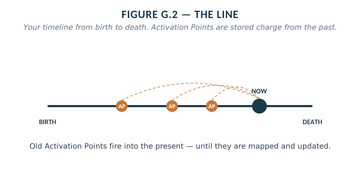
The signal isn't that you're upset. The signal is the mismatch — a three-out-of-ten situation producing an eight-out-of-ten reaction. That gap is the Line talking.
Use it when
- A situation is producing a reaction that feels disproportionate
- A specific person, place or sensory cue reliably triggers you
- You're reacting to what you predict will happen based on past experience
- You want an early-warning system for your own patterns
What to expect
The feeling may not get smaller. You will know whether you are answering this situation or an older one. That is a different question from whether it hurts.
"That happened before. This is now."
Why it works
The reaction isn't irrational. Associative memory networks operate below conscious awareness. A tone of voice, a smell, the way someone stands — any of these can activate a network formed in a completely different context, triggering the physiological and emotional response that belonged to the original event. That is the system doing exactly what it was built to do: use past experience to predict present threat. The problem arises only when then and now are not equivalent.
Memory is a reconstruction, not a recording. Elizabeth Loftus's work on reconstructive memory established that each time a memory is retrieved it is rebuilt from the current state of the neural network — your present mood, your current beliefs, and your body's regulatory state all shape what the memory "contains" at the moment of recall (Loftus, 1996). So the version of the past event driving today's reaction may not be the event; it's the event as reconstructed through everything that happened since. That is not a reason to distrust yourself. It's the reason the reaction can change without the past changing.
Naming the difference does physical work. Deliberately comparing then and now engages the prefrontal cortex and shifts the nervous system from automatic pattern-matching toward deliberate assessment.
In practice — a manager’s short email spikes real fear. What it recalls is a critical parent and the same drop in the stomach. One difference now: the clarifying question can be asked, and the job can be left.
If-Then plans
Implementation intentions are strong: pre-committing a response in the exact format "if [cue], then [response]" substantially improves follow-through, because the decision gets made while cognition is still available — before the activation point is reached (Gollwitzer, 1999).
If I feel tension in my chest and shortened breath during a conversation → I say "I need one moment" and step out. If I receive a critical message → I do not respond for twenty minutes. I run the Body Reset first. If I am tired, hungry and receiving demands at the same time → I name this combination aloud and reduce the request load.
Write one this week. WB 8.3 has blank templates.
The Trigger Map — six categories
Build this during a calm state. The full version is WB 2.4, and Session 11 covers it properly.
- People — who reliably activates a stress response, and what specifically do they do?
- Places — which environments shift your state, up or down?
- Situations — conflict, evaluation, uncertainty, loss of control?
- Sensory — sounds, smells, textures, tones of voice that carry associative weight
- Time and state — when are you most vulnerable? After what conditions — tired, hungry, isolated, overstimulated?
- Early body signal — what's the first physical sign, before the full response arrives?
Earlier interruption is almost always more effective than later intervention. At the start of a sequence the pathway hasn't fully activated; at the end, momentum is at its peak.
If you are supporting someone else
The script
"Is what you are feeling matching what is actually happening right now, or does it feel larger?" "What does this remind you of? When have you felt this before?" "What is one difference between that time and this situation?" "What do you have now that you didn't have then?"
For children
"That feeling is big. Is it about what is happening right now, or is part of it from before?" "Show me with your hands: how big is the feeling right now?" "This situation is different because… can you find one more?"
Never say this
| Don't | Why it fails |
|---|---|
| "You're overreacting." | The reaction is proportionate to the memory, even if not to the present |
| "Get over it." | Dismisses the Line entirely and increases shame |
| "That was years ago." | Time does not erase neural encoding. Only processing does |
| "You always do this." | Reinforces the identity of the pattern rather than separating it |
| "It's not that serious." | Compares the present stimulus to the present reaction without acknowledging the source |
"You're overreacting" is technically wrong, not merely unkind. The reaction is exactly proportionate — to something else.
The helper note — the parent's own Line
The most common reason a child's behaviour triggers an outsized parental response is that the child's behaviour has activated a network from the parent's own Line. A child's defiance may activate memories of helplessness. A child's distress may activate the parent's own unprocessed grief.
The Line Protocol is therefore a parenting tool, and you run it on yourself. Recognising when your response belongs to your Line rather than to the present moment is one of the most impactful things a parent can do — for the child and for the relationship. The same applies to partners, and to anyone you support.
Operational Rule
The reaction belongs to the Line. The response belongs to the Now.
This week — one thing
Write one If-Then plan. That's the whole assignment, and it's small on purpose.
If tonight stays with you: run the Body Reset before bed. The numbers at the top of this page work all night, every night.
In the workbook: WB 1.4 builds your own version. WB 2.4 is the full trigger map. WB 8.3 has
blank If-Then templates.
If you need next: The activation has become a repeating loop → Session 5 (next week). The body is too activated to think → Session 2. You want the full trigger map → Session 11.
Equipped With Agency · Session 4 of 17 · Next week: The Circle
Sources
The full entries for the research named on this page. Every one of them is also in the reference list at the back of the manual.
- Reconstructive memory: Loftus, E.F. (1996). Eyewitness Testimony. Harvard University Press. Loftus, E.F. & Palmer, J.C. (1974). Journal of Verbal Learning and Verbal Behavior, 13(5), 585–589.
- Implementation intentions: Gollwitzer, P.M. (1999). American Psychologist, 54(7), 493–503.